The traditional B2B SEO playbook, built on keywords and backlinks, is now obsolete. The ascent of generative AI and Google’s Search Generative Experience (SGE) has fundamentally altered the discovery and consumption of information. For the enterprise, this is not a tactical shift; it’s a strategic inflection point. SEO is no longer a marketing channel—it is a core business intelligence engine. This playbook provides a strategic framework to maintain visibility, build authority, and protect market share in a world of AI-driven, zero-click search.
Table of Contents
What’s Changing in B2B SEO with AI?
For years, SEO meant technical precision—keywords, backlinks, metadata. The rules were predictable, and we knew how to win. That playbook is now obsolete. In today’s landscape, AI reshapes how information is discovered, evaluated, and consumed. Search engines are no longer just indexing keywords—they’re interpreting intent, summarizing content, and serving zero-click results. B2B marketers must now see SEO not as a tactic, but as a business intelligence system.
How Does AI Understand Intent Instead of Just Keywords?
In the past, SEO was about matching what people typed into the search bar—specific keywords. But AI changes that by understanding why people are searching. This is called understanding intent. AI tools, like Google’s BERT (Bidirectional Encoder Representations from Transformers) analyze the full sentence structure and context of a query. Rather than just picking out a few keywords, they understand the meaning behind a question. That lets search engines serve more accurate and helpful answers. They consider:
- Context of the full sentence
- Word relationships
- Conversational tone and implied meaning
This means that instead of matching exact phrases, search engines now interpret semantic intent. For B2B marketers, this is a game-changer.
Why it matters:
- You no longer need to stuff keywords into pages.
- You can create content around user motivations, such as solving a pain point or comparing products.
- Search engines reward depth and clarity, not just keyword repetition.
For example:
- “challenges of on-premise server maintenance” – early-stage, problem-aware: user needs educational content.
- “benefits of cloud migration for finance sector” – mid-stage, solution-aware: user needs whitepapers or case studies.
- “AWS vs Azure vs Google Cloud pricing comparison” – late-stage, decision-making: user needs detailed comparison guides.
Instead of creating one page for “cloud storage,” marketers now need to create multiple assets that address these different intents across the buyer journey. AI doesn’t just match terms—it analyzes how different searches relate to each other, helping marketers build content that supports the complete decision journey.
What Is the Topic Cluster Model and Why Does It Matter Now?
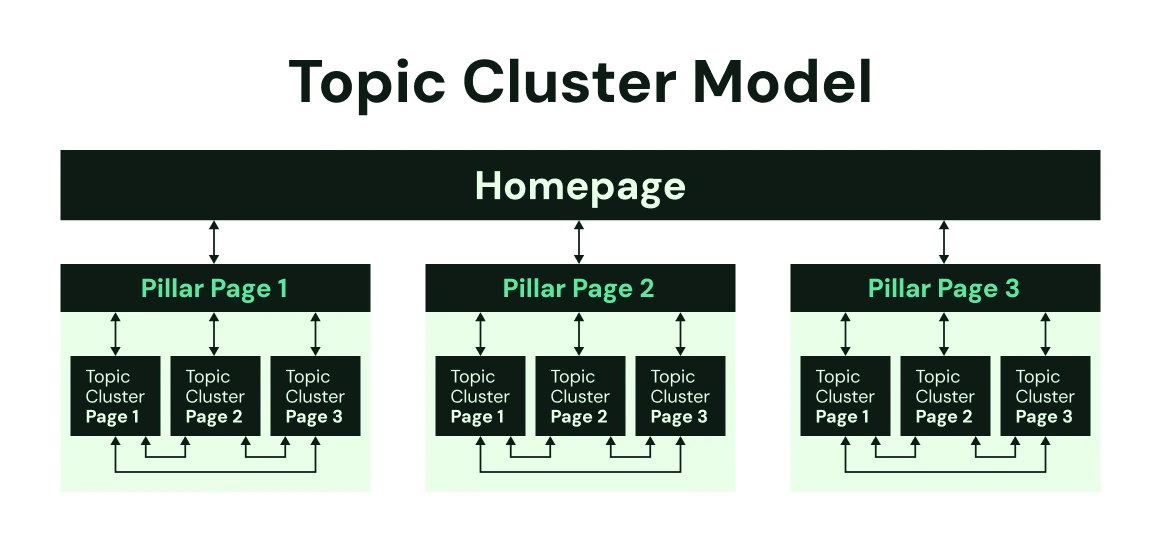 Search engines are also evolving how they assess authority. Rather than judging content by standalone pages, they now evaluate thematic depth across your site. The Topic Cluster Model addresses this shift by organizing your content around interconnected themes:
- A pillar page covers a broad subject comprehensively.
- Multiple cluster pages address specific subtopics and link back to the pillar
Why does this matter now?
- Google’s AI looks for content that’s well-organized and shows topical authority.
- Topic clusters show you understand the full picture, not just one narrow angle.
- They help search engines associate your site with deep knowledge of a subject, which is essential for ranking in AI-generated responses.
For B2B marketers, topic clusters support complex buying journeys. Your pillar page brings traffic in, while the cluster pages help users self-navigate based on their stage of awareness. This structure also future-proofs your SEO, as search becomes more conversational, well-organized topic ecosystems make it easier for AI models to extract relevant insights from your content.
How Do We Balance Generative AI and Human Thought Leadership?
Generative tools like MarketMuse or SurferSEO can draft outlines, analyze competitors, and suggest optimizations (MarketMuse). But your brand’s credibility still relies on:
- Human authorship and perspective
- Strategic prompting and editing
- SME validation and brand tone control
Your workflow should follow a “human-in-the-loop” model:
- 1. AI drafts ideas and structures
- 2. Marketers and SMEs inject insights
- 3. AI optimizes for search
- 4. Human reviews for tone, accuracy, and alignment
As Ann Handley says, “In an age of AI, our most human qualities are our most important competitive advantage” (Handley).
What’s the Impact of Google’s SGE on Visibility?
SGE introduces “zero-click searches,” where Google provides AI-generated answers at the top of the results page. To win visibility:
- Focus on E-E-A-T: Highlight author expertise, publish under named contributors, cite credible sources (Chi).
- Publish proprietary data: This makes your brand a primary source.
- Structure for clarity: Use the FAQ schema and Q&A format to make it easy for AI to extract answers.
How Should We Approach Technical SEO and Link Building with AI?
Technical SEO with AI
AI-powered tools can now perform technical SEO audits at scale and with greater depth:
- Tools like SEMrush, Ahrefs, and Screaming Frog—now AI-enhanced—can detect crawl errors, broken links, duplicate content, slow-loading pages, and poor mobile responsiveness instantly.
- AI can prioritize these issues based on impact, helping your team focus efforts for the greatest SEO return.
- Page speed and Core Web Vitals can be monitored automatically, with suggestions tied directly to content structure or code fixes.
AI also helps with intelligent internal linking, suggesting the most relevant pages to connect, improving crawlability and topic relevance.
Link Building with AI
Traditionally, link building was time-consuming and manual. Now:
- AI can identify authoritative domains by analyzing backlink profiles, traffic patterns, and relevance scores.
- Platforms like Clearscope, Moz, or HubSpot’s SEO tools use AI to recommend which sites to pitch for backlinks.
- AI-generated outreach emails can be tailored for each contact—adjusting tone, topic, and timing—to boost success rates.
You can even use predictive analytics to estimate which backlinks will have the highest influence on your rankings before doing outreach. Together, these capabilities reduce busywork and make technical SEO and link-building both strategic and scalable for B2B marketers. These improvements help boost domain authority and ranking reliability (MacGivia).
How Does AI Turn Data into Predictive SEO Insights?.
AI doesn’t just look at what happened—it helps forecast what to do next. It enables predictive modeling based on user data, search logs, and page-level engagement. Here’s how:
- Search Behavior Analysis: AI tools like Google’s Search Console Insights analyze billions of search queries and identify patterns in how users discover your site. Over time, AI recognizes emerging trends and signals changes in buyer interests before they hit mainstream.
- Crawl Log Intelligence: Tools like Botify use AI to analyze server logs and identify crawl patterns. You can detect if bots are missing critical pages or spending too much time on low-value URLs. AI then recommends how to optimize your site’s crawl budget so high-priority content gets discovered and indexed faster.
- Traffic and Conversion Prediction: Based on historic performance data, AI models can predict how much traffic a new topic might drive, or estimate how changing a title, meta description, or layout could affect conversions. This lets you prioritize content investments with confidence.
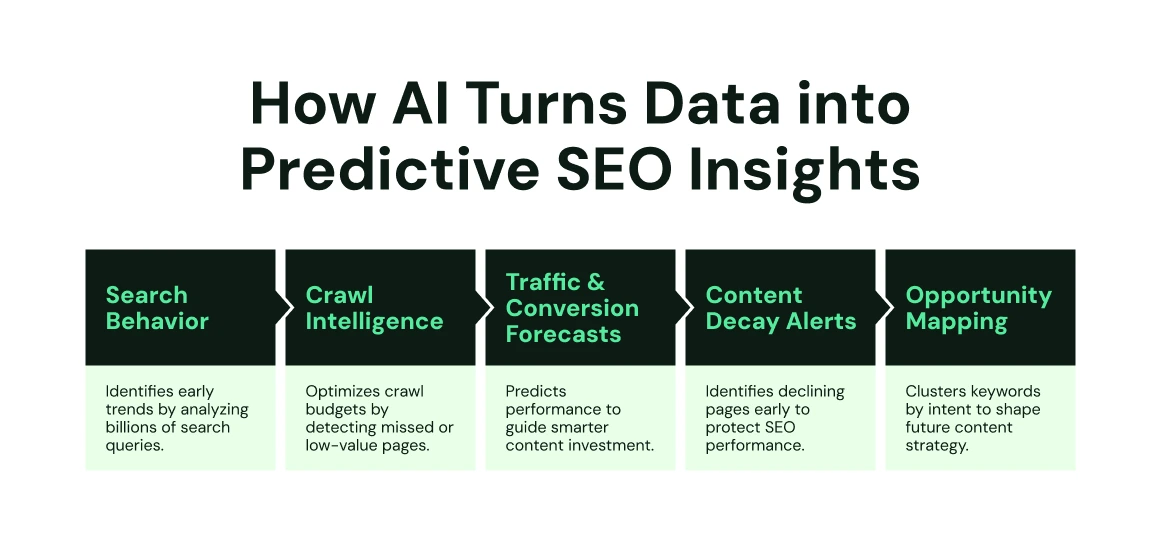
- Content Decay Detection: Predictive tools detect whenever evergreen content starts losing rankings. They automatically flag it for updates before performance drops significantly, helping you preserve SEO value.
- Future Opportunity Mapping: AI clusters keywords by intent and behavior, helping marketers map future content themes and supporting assets. Instead of reacting to trends, you’re building proactive, full-funnel content hubs based on forward-looking data.
This predictive SEO intelligence gives you the edge. Instead of optimizing in hindsight, you’re forecasting success and aligning SEO with business outcomes.
What Are the Biggest Challenges in AI-First SEO?
- 1. Cost and Team Skills: Requires investment in tools, training, and AI-literate team members
- 2. Data Privacy: Sharing data with public LLMs is risky; vet tools for security
- 3. Content Hallucinations: Generative tools can fabricate facts. Every draft must be fact-checked
- 4. Workflow Complexity: Requires integration across content, search, martech, and brand functions
What is a Marketer’s New Role in the AI Era?
The modern B2B marketer must:
- Think like a strategist: Direct AI and interpret data
- Act like an editor: Shape content, not just approve it
- Be an ethicist: Champion responsible use of AI
You’re no longer just optimizing for Google—you’re curating for human relevance and machine understanding. This is the new standard. Works Cited
- [1] Nayak, Pandu. “Understanding Searches Better Than Ever Before. “Google, Oct 25, 2019, https://blog.google/products/search/search-language-understanding-bert/.
- [2] “Content Planning. “MarketMuse, 2025, https://www.marketmuse.com/content-planning/.
- [3] Handley, Ann. “What Does AI Mean for Writers?” AnnHandley.com, http://www.annhandley.com/what-does-ai-mean-for-writers/.
- [4] Curt del Principe. “How AI is Impacting SEO + What to Do About It [Expert Interview], https://blog.hubspot.com/marketing/how-ai-is-impacting-seo.
- [5] Search Engine Journal, “8 Powerful Steps To Outrank Your Competition With Targeted SEO & AI-Informed Content”Search Engine Journal, Feb 15, 2024, http://www.searchenginejournal.com/ai-for-technical-seo/508441/.
- [6] Forbes, Forbes Agency Council, Nov 14, 2024, How To Leverage Artificial Intelligence To Improve SEO, https://www.forbes.com/councils/forbesagencycouncil/2024/11/14/how-to-leverage-artificial-intelligence-to-improve-seo/.

 Search engines are also evolving how they assess authority. Rather than judging content by standalone pages, they now evaluate thematic depth across your site. The Topic Cluster Model addresses this shift by organizing your content around interconnected themes:
 TW
TW 

 TW
TW 


